
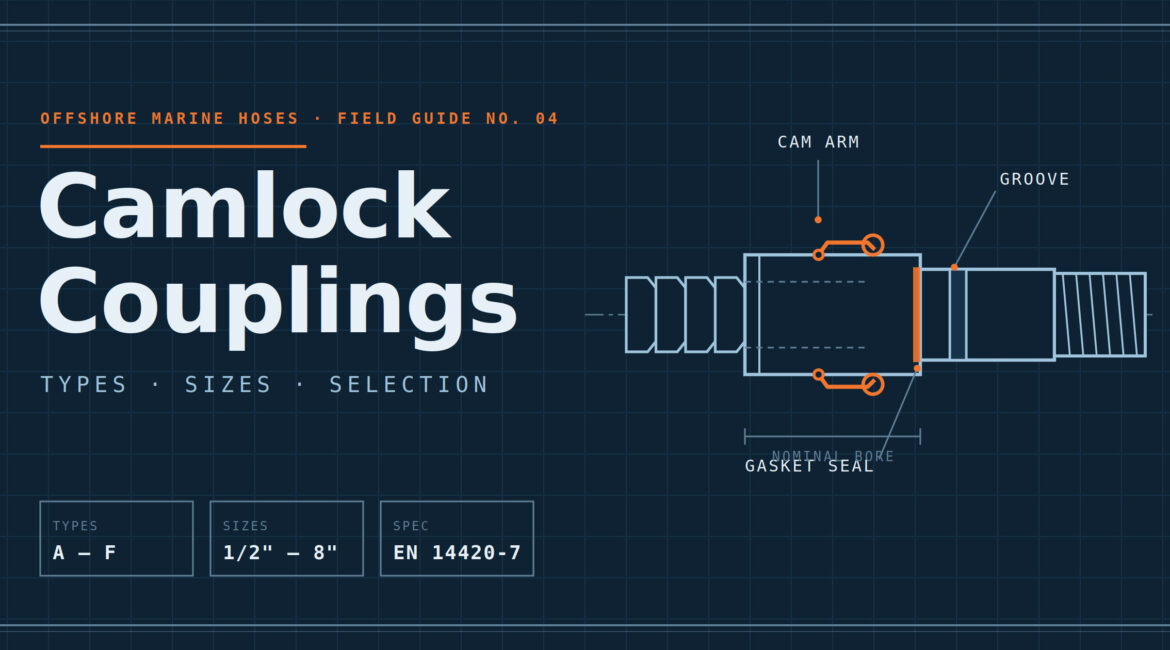
Camlock couplings — also known as cam and groove fittings — are one of the most widely used hose connection systems in fluid transfer. They allow hoses and pipework to be connected and disconnected in seconds without tools, which is why you will find them everywhere from fuel bunkering operations and chemical plants to agricultural pumping and dust suppression systems.
Despite their simplicity, choosing the wrong camlock is a common and sometimes costly mistake. Type, size, material and pressure rating all need to match the application, and in marine and fuel transfer settings the consequences of a poor match can include leaks, spills and regulatory breaches.
This guide explains how camlock couplings work, the six standard types, common sizes and materials, and how to select the right fitting for the job.
How a Camlock Coupling Works
A camlock connection has two halves:
- The coupler (female half) — a socket fitted with two cam arms.
- The adapter (male half) — a plain spigot with a machined groove.
To connect, the adapter is inserted into the coupler and the cam arms are folded down. The arms press against the groove, pulling the adapter tight against a gasket inside the coupler and creating a seal. Disconnection is the reverse: lift the arms and withdraw the adapter.
The design dates back to a US military specification, MIL-C-27487, developed for rapid fuel transfer. Most modern camlocks are manufactured to the commercial successor of that specification (A-A-59326) or to the European standard EN 14420-7, and fittings made to these standards are broadly interchangeable between manufacturers. That interchangeability is one of the main reasons the design has become an industry default.
The Six Camlock Types Explained
Camlock fittings are lettered A to F, plus dust caps and plugs. Each half is defined by two things: whether it is a coupler or an adapter, and how it terminates (thread, hose shank or flange).
| Type | Half | Termination | Typical use |
|---|---|---|---|
| Type A | Adapter | Female thread | Connecting a threaded pipe or tank outlet to a hose fitted with a coupler |
| Type B | Coupler | Male thread | Connecting a hose coupler to male-threaded equipment |
| Type C | Coupler | Hose shank | The most common hose-end fitting; clamps or swages onto the hose |
| Type D | Coupler | Female thread | Connecting threaded equipment to an adapter-ended hose |
| Type E | Adapter | Hose shank | Hose-end adapter; pairs with Type C, D or B couplers |
| Type F | Adapter | Male thread | Fixed adapter on pumps, tanks and manifolds |
| Dust cap (DC) | Coupler | Closed | Seals an open adapter when not in use |
| Dust plug (DP) | Adapter | Closed | Seals an open coupler when not in use |
A typical hose assembly uses a Type C coupler on one end and a Type E adapter on the other, with Type F adapters fixed to pumps and tank outlets. Dust caps and plugs are often treated as optional, but in fuel and chemical service they should be standard practice — they keep contamination out and residual drips in.
Flanged camlock variants are also available for connecting cam and groove hose systems directly to flanged pipework, common on tankers, jetty manifolds and terminal installations.
Standard Camlock Sizes
Camlock couplings are sized by nominal bore and typically range from 1/2″ up to 8″:
| Size | Common applications |
|---|---|
| 1/2″ – 3/4″ | Small chemical dosing, wash-down lines |
| 1″ – 1 1/2″ | IBC discharge, fuel polishing, light industrial transfer |
| 2″ | The most common size — fuel transfer, pump sets, tanker discharge |
| 3″ – 4″ | Bulk liquid transfer, tanker loading, marine bunkering |
| 6″ – 8″ | High-volume bulk transfer, dockside and terminal operations |
Two points worth checking before ordering:
- Size describes the bore, not the outside dimensions. A 2″ camlock fits a 2″ bore hose; couplers and adapters must be the same nominal size to mate.
- Larger sizes (5″+) vary more between manufacturers. Below 4″, interchangeability between brands made to the standard specifications is generally reliable. At 5″ and above, and with some non-standard patterns, always confirm compatibility before mixing manufacturers.
Camlock Materials: Which One Do You Need?
| Material | Strengths | Watch-outs | Typical service |
|---|---|---|---|
| Aluminium | Light, economical, good general corrosion resistance | Not suited to strong acids/alkalis; softer cam arms wear faster | Fuel, oils, water, dry bulk |
| Stainless steel (316) | Excellent chemical and seawater corrosion resistance, durable | Heavier, higher cost | Chemicals, food grade, marine and offshore |
| Brass | Good machinability, resists dezincification grades available | Not for ammonia or acetylene service | Water, fuel, general industrial |
| Polypropylene | Cheap, chemically inert to many media | Lower pressure and temperature limits, UV degradation | Agricultural chemicals, water, drainage |
| Nylon (glass-filled) | Tougher than polypropylene | Absorbs moisture; check chemical compatibility | Water, light chemical duty |
The gasket matters as much as the body. Standard couplers ship with nitrile (Buna-N) seals, which suit oils and fuels, but chemical service may need EPDM, Viton (FKM) or PTFE-encapsulated gaskets. Always check both the body material and the seal against the media being transferred — a chemical compatibility chart from the fitting or gasket manufacturer should be the first reference point.
In seawater and coastal environments, 316 stainless steel is usually the right call. Aluminium camlocks will survive marine use but pit over time, and galvanic corrosion becomes a risk where dissimilar metals meet on deck pipework.
Pressure Ratings and Limitations
Camlock couplings are a low-to-medium pressure connection. As a rough guide, working pressures run from around 5 bar (75 psi) for large polypropylene fittings up to 17 bar (250 psi) for small metal sizes — and ratings fall as size increases. Always work from the manufacturer’s published rating for the specific size and material, not a generic figure.
Just as importantly, standard camlocks are not a safety coupling:
- The cam arms can be opened while the line is pressurised, releasing the connection under load. Locking arms (with safety pins or lever locks) reduce the risk of accidental opening and should be specified for fuel and chemical duty.
- Camlocks provide no protection against hose pull-away. In transfer operations where a vessel, vehicle or tank could move while connected — bunkering, ship-to-shore transfer, tanker loading — the recognised safeguard is a marine breakaway coupling installed in the transfer line, which parts at a predetermined load and seals both ends to prevent spillage.
- They are not suitable for steam, and compressed air service requires specifically rated fittings.
For marine transfer work, industry guidance from the Oil Companies International Marine Forum (OCIMF) covers hose and transfer system integrity, and in the UK the Health and Safety Executive publishes guidance on the safe transfer of flammable liquids. In the US, facilities handling oil are subject to the EPA’s Spill Prevention, Control and Countermeasure (SPCC) rule, which makes secure, well-maintained transfer connections a compliance issue as well as a safety one.
How to Choose the Right Camlock: A Five-Step Checklist
- Identify what each end connects to. Threaded outlet, hose tail or flange? This determines the type letters you need. Most hose assemblies resolve to C + E.
- Match the size to the hose bore and required flow rate. Undersized couplings throttle flow and increase velocity; for bulk transfer, 3″–4″ is usually the minimum worth considering.
- Check media compatibility — body and gasket. Confirm both against a compatibility chart for the fluid, its concentration and temperature.
- Confirm the pressure rating with a margin. Include surge pressure, not just steady-state operating pressure. Water hammer on pump start-up and valve closure is a common cause of coupling failure.
- Assess the consequences of accidental disconnection. If the answer involves fuel, chemicals, the environment or people, specify locking cam arms as a minimum, and consider whether the transfer system needs an engineered safeguard such as a breakaway coupling upstream of the camlock connection.
Inspection and Maintenance
Camlocks are simple, but they are also frequently the most abused component in a transfer system. A basic inspection routine pays for itself:
- Gaskets — inspect before each use in fuel/chemical service; replace at the first sign of swelling, flattening or cracking. Gaskets are consumables.
- Cam arms and pins — check for bent arms, worn pins and missing safety clips. Arms should close with firm, even resistance.
- Grooves and sealing faces — look for scoring, dents and corrosion pitting, particularly on aluminium adapters.
- Fit — a connection that closes too easily is telling you the groove or arms are worn. Retire it.
Damaged camlocks are cheap to replace and expensive to keep in service.
Frequently Asked Questions
What does “camlock” mean?
The name comes from the cam-shaped levers (cam arms) on the coupler that lock into the groove on the adapter. The generic term is “cam and groove coupling” — camlock is the name in everyday use.
Are camlock fittings universal between brands?
Generally yes for sizes up to 4″, where fittings are made to A-A-59326 (the successor to MIL-C-27487) or EN 14420-7. At 5″ and above, or with non-standard patterns, check compatibility before mixing manufacturers.
What sizes do camlock couplings come in?
Standard sizes run from 1/2″ to 8″ nominal bore. 2″ is the most common general-purpose size; bulk and marine transfer typically uses 3″ to 6″.
Can camlock fittings be used for fuel?
Yes — camlocks originated as a fuel transfer fitting. For fuel service, use metal-bodied fittings with nitrile or Viton gaskets, specify locking cam arms, and ensure the wider transfer system addresses spill and pull-away risk in line with the relevant regulations.
What is the difference between a Type C and Type E camlock?
Both are hose-shank fittings. Type C is the female half (coupler, with cam arms); Type E is the male half (adapter, with the groove). A hose with a C on one end and an E on the other can daisy-chain to further hose lengths.
Can you use camlock couplings for compressed air or steam?
Not standard fittings. Steam is excluded entirely, and compressed air requires fittings specifically rated and secured for air service. Accidental release under air pressure turns a hose into a serious hazard.
Selecting couplings for a marine or bulk transfer application? Our team advises on complete hose and transfer assemblies, from cam and groove fittings to floating and submarine hose systems. [Get in touch] for specification support.